Spectrometer
Aim
Determination of the Wavelengths of Spectral Lines of Mercury Source Using Diffraction Grating
Apparatus
- Mercury vapor lamp
- Diffraction grating
- Spectrometer
- Collimator
- Telescope
- Prism table or grating holder
- Spirit level
- Ruler or vernier scale
Pre-Lab Questions
- What is a diffraction grating?
A diffraction grating is an optical device with equally spaced parallel slits that diffract light into its component wavelengths due to interference. - How does a diffraction grating differ from a prism?
A grating disperses light via diffraction and interference, producing sharper spectral lines, while a prism uses refraction. - What is the significance of the grating constant?
The grating constant (d) determines the angles of constructive interference and is key to calculating wavelengths. - Why use a mercury lamp?
Mercury lamps emit distinct spectral lines, ideal for studying discrete spectra. - Explain diffraction of light in simple words.
Diffraction of light is the bending of light waves as they pass through a narrow opening or around an obstacle - What is the use of telescope and collimeter in spectrometer?
In a spectrometer, the telescope and collimator play crucial roles in analyzing light:
Collimator: Converts light from a source into a parallel beam, ensuring the light rays are aligned and focused for accurate spectral analysis.
Telescope: Magnifies and focuses the diffracted light from the grating, allowing precise observation and measurement of spectral lines.
Theory
When light passes through a diffraction grating, it undergoes diffraction and interference, resulting in the formation of multiple spectral lines. The grating equation \( n\lambda = d \sin\theta \) governs the relationship between the wavelength of light (\( \lambda \)), the grating spacing (\( d \)), and the angle of diffraction (\( \theta \)). Here, \( n \) is the order of the spectrum. The mercury vapor lamp emits light at specific wavelengths corresponding to electronic transitions in mercury atoms. These wavelengths appear as distinct spectral lines, such as violet (404.7 nm), blue (435.8 nm), green (546.1 nm), and yellow (577.0 nm and 579.1 nm). By measuring the angles at which these lines appear, their wavelengths can be determined using the grating equation.
Working Formula
Light from a mercury lamp diffracts through a grating, producing spectral lines at angles governed by:
\[ \lambda = \frac{2.54 sin \theta}{nN} \] Where- θ is the diffraction angle,
- n is the diffraction order,
- λ is the wavelength
- N is number of parallel lines per inch in grating element
Least Count
\[ L C = \frac{\text{One Main scale division in angle}}{\text{Number of Vernier Scale divisions}} \] \[L C = \frac{0.5 \text{ degree}}{30} = 0.016 \text{ degrees} \]Diagram
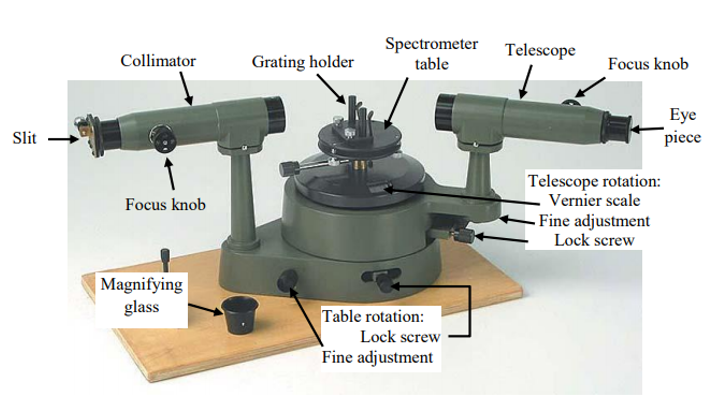
Procedure
Setup and Calibration:
- Switch on the Mercury Source and allow it to warm up for a few minutes to stabilize the light output.
- Level the spectrometer using the spirit level to ensure accurate measurements.
- Adjust the collimator to obtain a fine and well-defined beam of white light. Make sure the slit of the collimator is narrow to improve resolution.
- Adjust the eyepiece of the spectrometer to focus the crosswire clearly.
Observation of Diffraction Pattern:
- Due to diffraction, the constituent colors of white light (blue, green, and red) will appear symmetrically on both sides of the central white light.
- Focus the crosswire on the blue color in the first-order diffraction pattern on the left side.
- Record the Main Scale Reading (M.S.R.) and Vernier Coincidence (V.C.) for both the vernier scales (V1 and V2).
Repeat for Other Colors:
- Repeat the process for the green and red colors of the first-order diffraction pattern.
- Similarly, perform the same procedure for the first-order diffraction pattern on the right side of the central white light.
- Record the M.S.R. and V.C. readings for blue, green, and red colors on both the left and right sides in a table for clarity.
Calculation of Diffraction Angle (θ):
- The difference between the readings for a specific color on the left and right sides will give the value of 2θ.
- Average the Vernier readings (V1 and V2) to get the final 2θ value.
Observation Table
| Sl. No. | Color | Vernier scale | Spectrometer Reading | 2θ = a ∼ b | θ | θ Average | |
|---|---|---|---|---|---|---|---|
| Left (a) M.S.R + (V.C × L.C.) |
Right (b) M.S.R + (V.C × L.C.) |
||||||
| 1 | Blue | V₁ | |||||
| V₂ | |||||||
| 2 | Green | V₁ | |||||
| V₂ | |||||||
| 3 | Red | V₁ | |||||
| V₂ | |||||||
Calculations
Blue Color
\[ \lambda_{blue} = \frac{2.54 sin \theta}{nN} \]Example:
\[ \lambda_{blue} = \frac{2.54 \times sin(13^o)}{1\times 12500} = \frac{0.56896}{12500} \] \[ \lambda_{blue} = 4.55 \times 10^{-5} cm \] \[ \lambda_{blue} = 4.55 \times 10^{-5} \times 10^{-2} m \] \[ \lambda_{blue} = 455 \times 10^{-2} \times 10^{-5} \times 10^{-2} m \] \[ \lambda_{blue} = 455 \text{ nm} \]Green Color
\[ \lambda_{green} = \frac{2.54 sin \theta}{nN} \]Red Color
\[ \lambda_{red} = \frac{2.54 sin \theta}{nN} \]Violet Color
\[ \lambda_{violet} = \frac{2.54 sin \theta}{nN} \]Precautions
- Level the spectrometer.
- Align grating perpendicularly.
- Use a low-intensity reading lamp.
- Handle grating by edges.
Applications
- Determining unknown wavelengths.
- Calibrating optical instruments.
- Studying atomic structure.
- Analyzing stellar composition.
- Quality control of light sources.
Post-Lab Questions
- Why does red color deviates the most in grating?
In a diffraction grating, the amount of deviation (or bending) of light depends on its wavelength. Red light has the longest wavelength in the visible spectrum. - In this experiment, what type of diffraction occurs? Fresnels or Fraunhofer? Justify your answer
In the diffraction grating experiment, Fraunhofer diffraction occurs because the light source and screen are effectively at infinite distances (using a collimator and telescope), and the light waves are parallel, satisfying Fraunhofer conditions - How diffraction grating can separate the colors of light?
When a wavefront of light hits the grating, each slit acts as a new source of secondary wavefronts (Huygens' principle).These secondary wavefronts interfere constructively at specific angles depending on the wavelength (λ), causing different colors to diffract at different angles and separate into a spectrum.
Outcomes
- Determine the wavelengths different light sources (e.g., ~405 nm, ~436 nm).
- Demonstrated λ vs. θ relationship.