Young’s Double Slit Experiment – Interference of Light (YDSE)
Quick Exam Notes
- Condition for Interference: Two coherent light sources (same frequency and constant phase difference) are required.
- Condition for Bright Fringe: \( \Delta x = n \lambda \)
- Condition for Dark Fringe: \( \Delta x = (2n + 1)\frac{\lambda}{2} \)
- Fringe Width: \( \beta = \frac{D \lambda}{d} \)
- Key Point: Fringe width increases with wavelength \( (\lambda) \) and screen distance \( (D) \), but decreases with slit separation \( (d) \).
- Central Bright Fringe: Occurs at the center where path difference = 0; this is the point of maximum intensity.
In 1801, Thomas young first demonstrated experimentally the phenomenon of interference of light. The experimental setup consists of a single source ’S’ from which light rays travel and incident on two pinholes S1, and S2, as shown in Figure. Now S1, and S2, act as two coherent sources. The distance (d) between S1, and S2, is of order of the wavelength of light and emit spherical wave fronts. According to Huygen’s wave theory, each point on these spherical wave fronts acts as secondary sources. The emitted secondary wavelets by the two sources overlap each other and forming interference patterns.
When the crest of one wave front overlaps with crest of another wave front (or trough of one wave front with trough of another wave front), constructive interference takes place. Similarly, when the crest of one wave front overlaps with the trough of second wave front, destructive interference pattern takes place. Hence all the points corresponding to constructive interference form bright bands and all points corresponding to destructive interference form dark bands in the interference pattern.
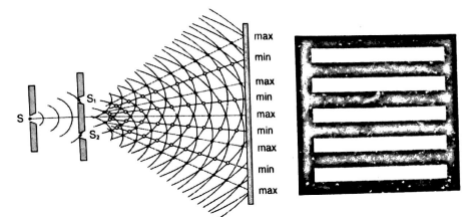
Derivation of the intensity of fringe
Let \( y_1 \) is the displacement produced at point P due to source \( S_1 \). It is given by
\[ y_1 = a_1 \sin \omega t \tag{1} \]where \( a_1 \) is the amplitude of wave train given by \( S_1 \) and \( \omega \) is its angular frequency. Similarly, let \( y_2 \) be the displacement produced by \( S_2 \) at point P due to source \( S_2 \). It is given by
\[ y_2 = a_2 \sin (\omega t + \delta) \tag{2} \]According to the principle of superposition, the resultant displacement at P is given by
\[ y = y_1 + y_2 = a_1 \sin \omega t + a_2 \sin (\omega t + \delta) \tag{3} \] \[ y = a_1 \sin \omega t + a_2 \sin (\omega t) \cos \delta + a_2 \cos (\omega t) \sin \delta \tag{4} \] \[ a_1 + a_2 \cos (\delta) = R \cos (\theta) \tag{5} \] \[ a_2 \sin \delta = R \sin (\theta) \tag{6} \]Where \( R \) and \( \theta \) are new constants. Squaring and adding equations 5 and 6, we get
\[ R^2 \sin^2 \theta + R^2 \cos^2 \theta = (a_1 + a_2 \cos \delta)^2 + (a_2 \sin \delta)^2 \tag{7} \] \[ R^2 = a_1^2 + a_2^2 + 2 a_1 a_2 \cos \delta \tag{8} \]Hence resultant intensity at point P is,
\[ I = R^2 = a_1^2 + a_2^2 + 2 a_1 a_2 \cos \delta \tag{9} \]i) Condition for maximum intensity
\( I = I_{max} \) intensity at P is max, when \( \cos \delta = 1 \Rightarrow \delta = 2n\pi \)
Since, phase difference
\[ \delta = \frac{2\pi}{\lambda} \text{ (path difference)} \tag{10} \] \[ \frac{2\pi}{\lambda} (S_2P - S_1P) = 2n\pi \tag{11} \] \[ I_{max} = a_1^2 + a_2^2 + 2a_1a_2 = (a_1 + a_2)^2 \tag{12}\]So the intensity at point P is maximum when path difference between two rays reaching point P is equal to n times of \( \lambda \), where \( n = 0, 1, 2, 3, \ldots \)
ii) Condition for minimum intensity
Intensity at P is minimum \( I = I_{min} \), where \( \cos \delta = -1 \Rightarrow \delta = (2n + 1)\pi \)
\[ \delta = \frac{2\pi}{\lambda} \text{ (path difference)} \tag{13} \] \[ \frac{2\pi}{\lambda} (S_2P - S_1P) = (2n + 1)\pi \tag{14} \] \[ S_2P - S_1P = (2n + 1) \frac{\lambda}{2} \tag{15} \] \[ I_{min} = a_1^2 + a_2^2 - 2a_1a_2 = (a_1 - a_2)^2 \tag{16} \]So intensity at point P is minimum, when the path difference between two rays reaching P is odd number times of \( \lambda / 2 \).
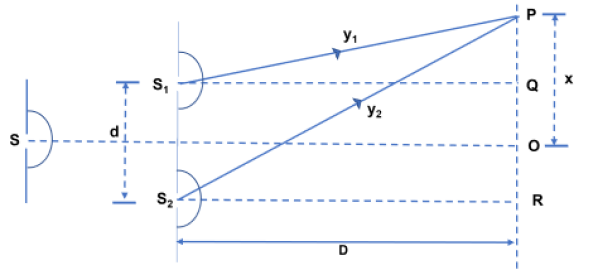
Derivation of fringe width \( (\beta) \)
Let us consider a point P on the screen at a distance X from the center point O. From right angle \( S_1PQ \)
\[ (s_{1P})^2 = (s_1Q)^2 + (QP)^2 \tag{17} \] \[ y_1^2 = (x - d/2)^2 + D^2 \tag{18} \]From right angle \( S_2PR \),
\[ (s_{2P})^2 = (s_2R)^2 + (RP)^2 \tag{19} \] \[ y_2^2 = (x + d/2)^2 + D^2 \tag{20} \]Subtracting
\[ y_2^2 - y_1^2 = \big[ (x + d/2)^2 + D^2 \big] - \big[ (x - d/2)^2 + D^2 \big] \tag{21} \]According to \( a^2 - b^2 = (a + b)(a - b) \)
\[ (y_2 - y_1)(y_2 + y_1) = 2xd \tag{22} \] \[ y_2 - y_1 = \frac{2xd}{y_2 + y_1} \tag{23} \]Since the distance between slits and screen is large, \( S_2P + S_1P = 2D \), i.e., \( y_1 + y_2 = 2D \)
\[ y_2 - y_1 = \frac{xd}{D} \tag{24} \]The path difference is
\[ \frac{xd}{D} \]For bright fringe, the path difference is \( S_2P - S_1P = n \lambda \)
\[ \frac{xd}{D} = n \lambda \Rightarrow x = \frac{n \lambda D}{d} \tag{25} \]The distance of first bright fringe from 'O' is given by, for \( n = 1 \),
\[ x_1 = \frac{\lambda D}{d} \]The distance of second bright fringe, for \( n = 2 \),
\[ x_2 = \frac{2 \lambda D}{d} \]The distance of third bright fringe, for \( n = 3 \),
\[ x_3 = \frac{3 \lambda D}{d} \]The distance between the adjacent bright fringes is given by
\[ x_2 - x_1 = \frac{2 \lambda D}{d} - \frac{\lambda D}{d} = \frac{\lambda D}{d} \tag{26} \]The spacing between consecutive dark fringes is equal to
\[ \frac{\lambda D}{d} \]Hence fringe width,
\[ x_2 - x_1 = \frac{\lambda D}{d} = \beta \]Hence the wavelength of the source of light \( \lambda \) is given by
\[ \lambda = \frac{\beta d}{D} \]Multiple Choice Questions (MCQs)
-
In Young’s double slit experiment, the interference pattern is due to:
- a) Reflection of light
- b) Refraction of light
- c) Diffraction and interference of light
- d) Polarization of light
Answer
c) Diffraction and interference of light
-
In Young’s double slit experiment, the fringe width β is given by:
- a) β = Dλ/d
- b) β = λd/D
- c) β = Dd/λ
- d) β = λ/(Dd)
Answer
a) β = Dλ/d
-
If the wavelength of light used in YDSE is doubled, the fringe width will:
- a) Become half
- b) Become double
- c) Remain unchanged
- d) Become one-fourth
Answer
b) Become double
-
In YDSE, if one of the slits is closed, the pattern observed on the screen will be:
- a) No fringes, only uniform illumination
- b) Dark and bright fringes alternately
- c) A single bright fringe
- d) Coloured bands
Answer
a) No fringes, only uniform illumination
-
In Young’s double slit experiment, if the screen is moved away from the slits, the fringe width will:
- a) Decrease
- b) Increase
- c) Remain the same
- d) Disappear
Answer
b) Increase