Applications of C Programming
1. Why C is Used in the Real World
C programming language is widely used in real-world applications because of its efficiency, speed, portability, and low-level memory access. C allows programmers to interact closely with hardware while still providing high-level programming constructs.
Due to these features, C is preferred in applications where performance and resource optimization are critical.
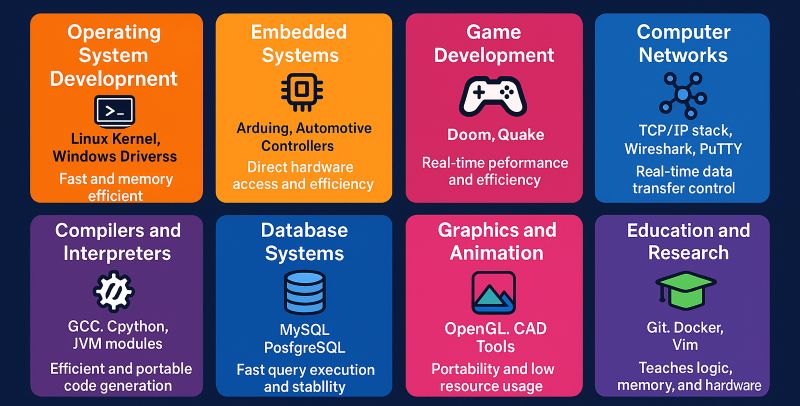
2. Operating Systems
C is extensively used in the development of operating systems. Most operating systems are either fully or partially written in C because it supports low-level operations such as memory management and process control.
Examples include:
- UNIX operating system
- Linux kernel
- Windows kernel components
3. Embedded Systems
Embedded systems are dedicated systems designed to perform specific tasks. C is the most commonly used language in embedded systems due to its efficiency and direct access to hardware resources.
C is used in:
- Microcontroller programming
- Consumer electronics
- Automotive control systems
- Medical devices
4. Compilers and Interpreters
C is widely used to develop compilers, interpreters, and language runtimes. Many programming languages use compilers or interpreters written in C for performance reasons.
Examples include:
- C compiler (GCC)
- Python interpreter (CPython)
- Java Virtual Machine components
5. Game Development
C is used in game development where high performance and real-time processing are required. It is commonly used in game engines and graphics programming.
C provides direct control over memory and hardware, making it suitable for developing fast and responsive games.
6. Scientific Applications
C is widely used in scientific and engineering applications that require high computational speed and accuracy.
Applications include:
- Numerical simulations
- Scientific modeling
- Data analysis tools
- Physics and engineering software
7. Advantages in Industry
The continued use of C in industry is due to the following advantages:
- High execution speed
- Efficient memory management
- Portability across platforms
- Availability of compilers and libraries
- Strong foundation for learning other languages
8. Summary
- C is widely used in system-level and performance-critical applications.
- It plays a major role in operating systems and embedded systems.
- C is essential in compiler development and scientific computing.
- The language remains highly relevant in modern industry.